The Diagnostic Power of Friction
Disability is often framed as a deficit to be managed. In reality, it is a high-resolution sensor for the design flaws and commercial opportunities that everyone else is too comfortable to notice.
Cristian Brownlee
Author
The conventional view of disability is, to put it politely, a crashing bore. It is a world of compliance forms, "reasonable adjustments," and ticking boxes that sit somewhere between fire safety protocols and the annual tax return. It is a "deficit model" that views difference as a problem to be solved, or worse, a cost to be minimised.
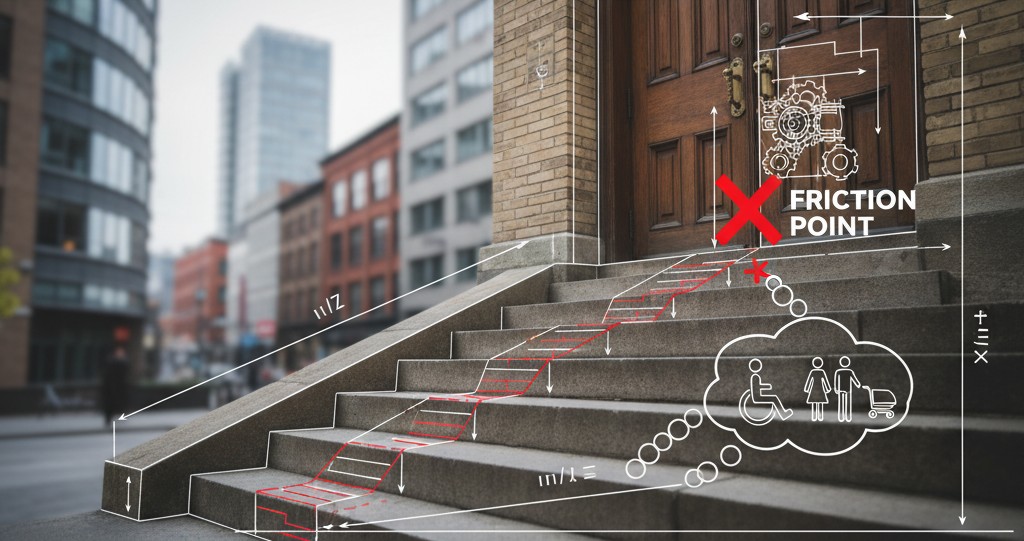
What if this framing is entirely backwards? What if your specific constraints are not a "lack," but a superior diagnostic tool? In my experience, both as a wheelchair user and an entrepreneur, disability acts as a built-in detector for the absurdities and frictions that the "standard" world is blissfully blind to.
The Genius of the Pavement
Consider the humble curb cut: that simple dip in the pavement. When these were first proposed, the "sensible" argument was that they were an expensive accommodation for a tiny niche of wheelchair users. It was seen as a charity-led cost, a concession for the few.
But the moment they were installed, the reality changed. The wheelchair user was merely the "canary in the coal mine" who could articulate the problem: "that six-inch slab of concrete is a pointless barrier." Once removed, the value exploded. Parents with prams, delivery drivers with heavy trolleys, travellers with suitcases, and even people who just found it easier on their knees all used the "accommodation."
The curb cut wasn't an "accessibility feature." It was simply a better way to design a pavement. The "extreme" user provided the insight that led to universal value. This is the "Curb-Cut Effect" in action, and it is a blueprint for how we should approach every business challenge.
The High-Value Asset Class
At Rise Beyond Barriers, we don't look for people who have "overcome" their circumstances. We look for people who have mastered them. When you navigate a world that wasn't built for you, you become a specialist in identifying hidden friction. You see the "human-proof" packaging, the unnecessarily complex checkout process, and the brittle workflows that everyone else accepts as "just the way things are."
In the research I contribute to for inclusive space systems, we call this searching for "critical failure data." We want to know how a system behaves under extreme stress or in a vacuum. If a process requires a specific, narrow set of conditions to work, it isn't a good process: it’s a fragile one. A founder with a disability is essentially a piece of hardware that has been stress-tested in the real world. They don't need a focus group to find the flaws in your strategy: they live in the gaps where those strategies fail.
Friction is a Compass
The business world is currently drowning in "best practice" and safe, mediocre solutions. What it actually needs is the perspective of the outsider. It needs the "battlefield" insight of someone who knows exactly where a system breaks down.
If you find yourself facing a barrier, stop trying to find a way around it for a moment. Instead, look at the barrier itself. Why is it there? Who else is it stopping? Is it a signal of a massive, untapped market that your competitors are too comfortable to see?
"True innovation is the ability to see a point of profound frustration and recognise it for what it truly is: a staggering business opportunity in disguise."
Stop listening to the people who tell you how things "usually" work. Start trusting the friction. It is telling you precisely where the gold is buried. You aren't here to be "accommodated": you are here to show the rest of the world how to build something that actually works.